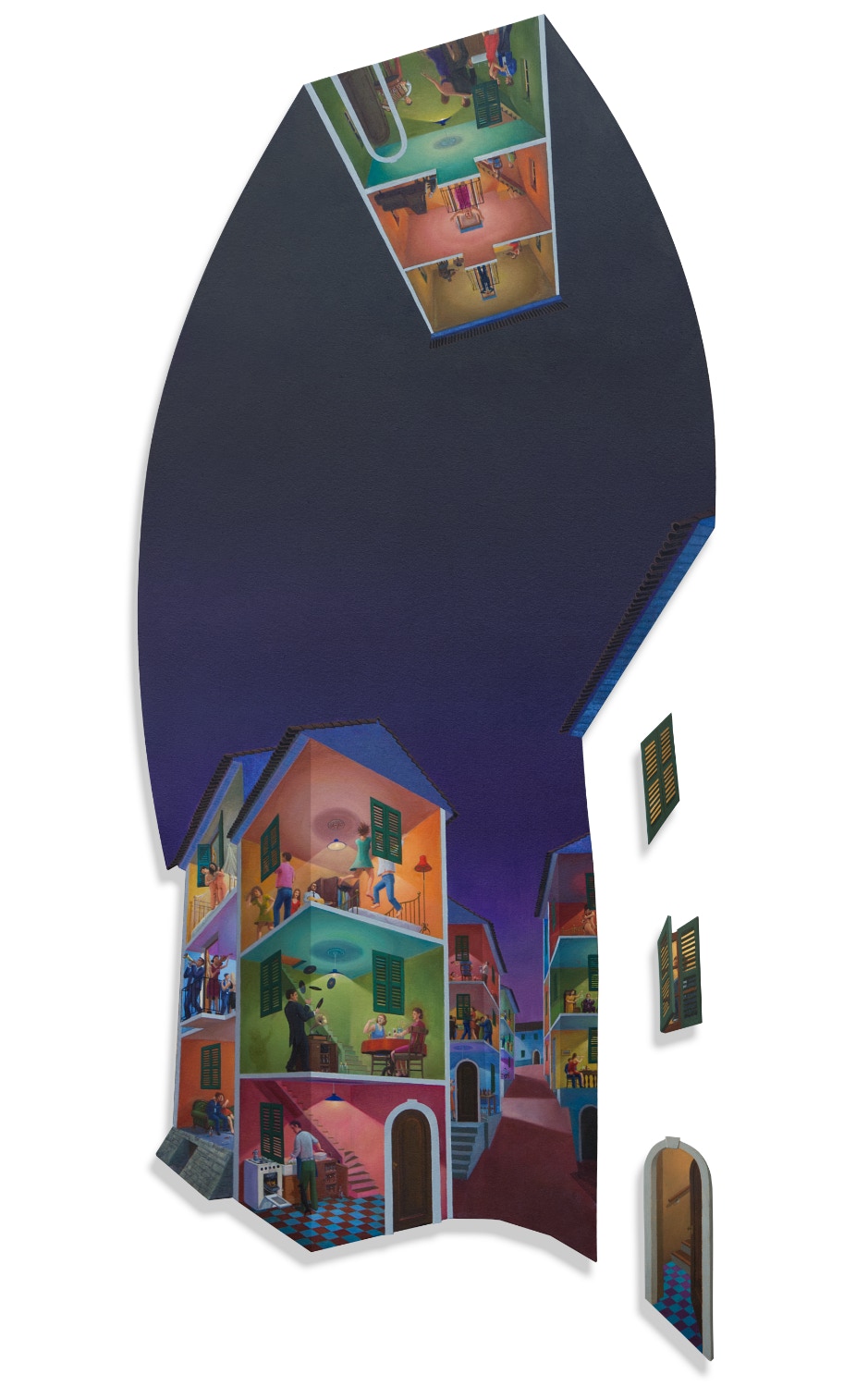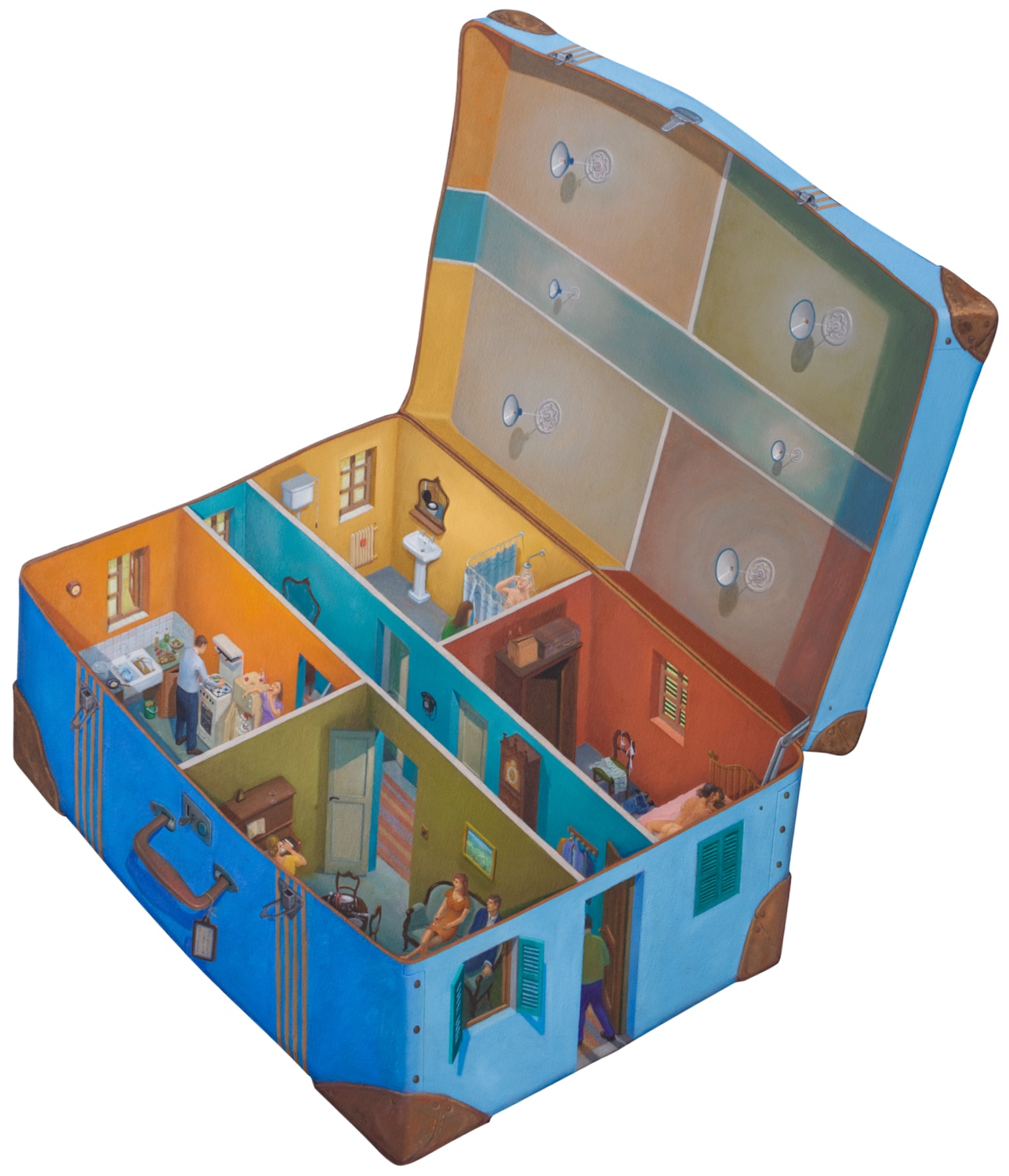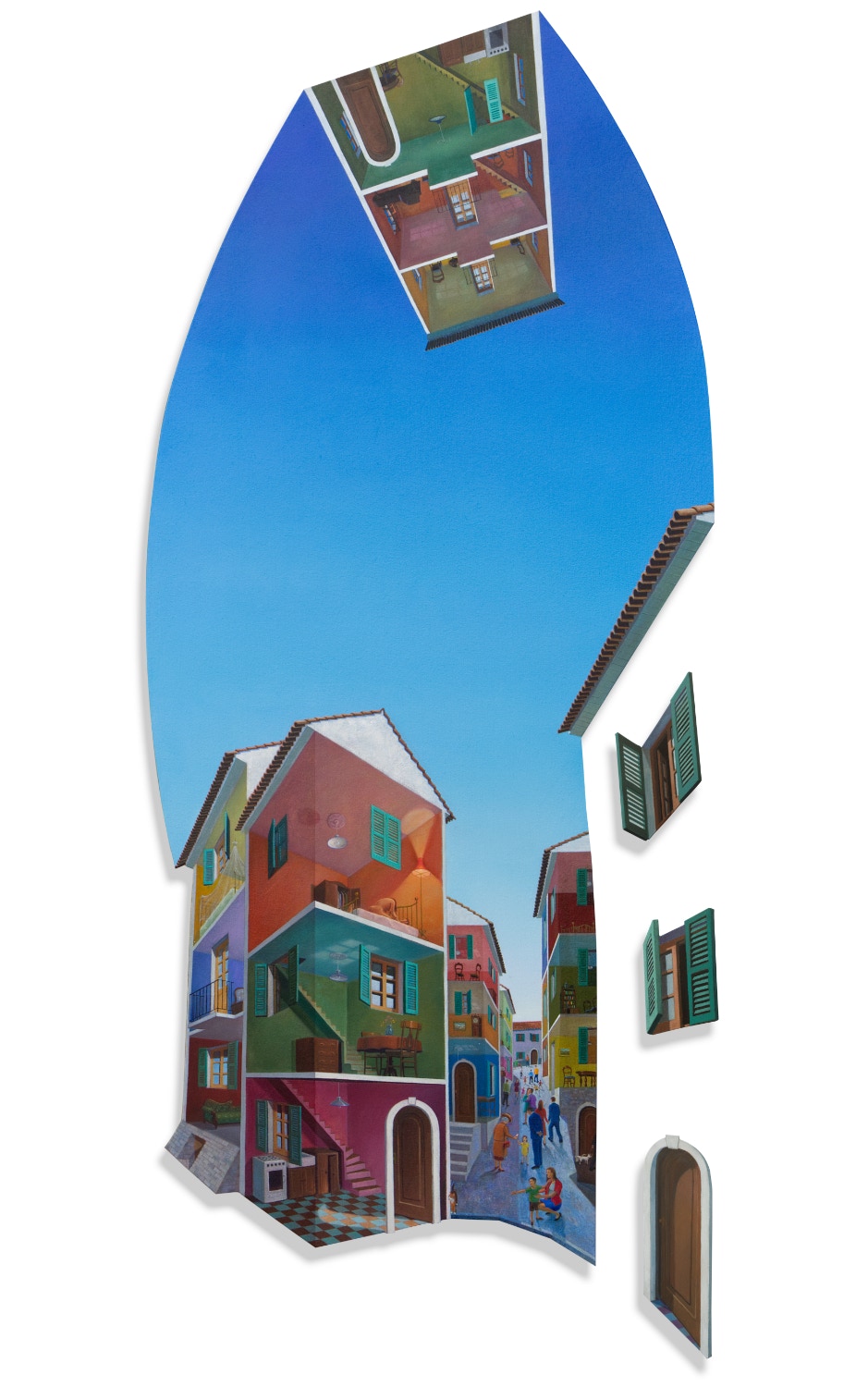
Life In The Village
203 x 85 cm (in 4 pieces)
All Night Party In The Village
203 x 85 cm (in 4 pieces)
The Mobile Home
117 x 91 cm
Introducing Paul Critchley means introducing an artist who has made the gaze a tool for knowledge. Not a fixed, immobile gaze, anchored to a single point of observation, but a mobile gaze, capable of traversing time, memory, and space.
The artist himself states: "In my paintings, I use more than one viewpoint to better represent my surroundings. To do this, I must stretch and distort the perspective designed to show space from a single viewpoint. For me, this fixed viewpoint is restrictive because our perception of our environment depends on memory which combines many different viewpoints, much like a visual puzzle."
In these words, we find the core of his artistic poetry.
Our experience of the world is never static. When we remember a room, a house, a square, or a landscape, we don't retain a single photographic image of it. Memory constructs a synthesis of different moments, different lights, and emotions experienced at different times. It is precisely this complex reality that Critchley seeks to convey through painting.
Born in Rainford, England, in 1960, Paul Critchley grew up in a context deeply rooted in British artistic tradition. After studying at the Art Institute and then at the School of Fine Arts, he made an unconventional choice; Instead of pursuing an academic career, he decided to leave his home country.
In 1985, he moved to West Berlin. The city was still divided by the Wall at the time and was a symbol of political and cultural tensions in twentieth-century Europe. For the young artist, that experience became a true lesson in life.
Critchley has recounted how he felt it was insufficient to go directly from student to teacher. He felt the need to experience the real world, to engage with different cultures, to experience new and often unpredictable situations.
In the years that followed, his life took the form of a long journey. France, the Netherlands, Spain, the United States, Russia and finally Italy, all became stages in a quest that was not only artistic but also existential.
However this constant movement did not lead to rootlessness. On the contrary, it generated an ever-deeper reflection on the meaning of living.
What is a home?
Is it a physical construction?
Is it a place?
Is it a memory?
Is it a mental state?
These questions permeate his entire production.
For many years, Critchley has lived in Farindola, a small town in the Abruzzo hinterland. Here, he has found a place that allows him to observe the passage of time, its architecture, with a careful and contemplative gaze. Many of his works stem precisely from the observation of everyday life. There is no search for the extraordinary. On the contrary, the artist finds mystery in ordinary things: a slightly open window, a closed door, a room illuminated by afternoon light, a house observed from the outside. These are elements that belong to everyone's experience and which, precisely for this reason, become powerful tools for reflection.
One of the most original aspects of his work is represented by his shaped canvases. Since 1978, Critchley has been experimenting with forms that abandon the traditional rectangular shape. For centuries, the painting has been considered an ideal window through which to observe the world. The English artist, however, takes a radical step. He eliminates the traditional frame and shapes the canvas following the actual shape of the object represented. A painted window takes the form of a window. A door takes the shape of a door. A shutter itself becomes a pictorial support. The work does not simply represent an object. It becomes an object itself.
In this way, the distance between reality and representation is reduced to the point of almost disappearing. This is where one of the central themes of his research comes in: the relationship between reality and simulation.
In recent decades, philosophers and artists have long reflected on the simulacrum, on the possibility that images can replace reality itself. Critchley chooses neither reality nor illusion. He chooses to place himself in an intermediate space. His works are both real and illusory at the same time.
We can visually open a painted window.
We can observe a room beyond a painted door.
We can perceive the depth of space.
Yet we are always aware that we are standing before a painting. This continuous dialogue between what we see and what we know generates an extremely engaging perceptual experience.
The window thus takes on a fundamental role. In Western tradition, the window is a symbol of openness to the world. For Critchley, it becomes something even more complex.
It is a threshold.
A passageway.
A place where inside and outside meet.
Where the past dialogues with the present.
Where memory meets experience.
Observing his works, one often feels invited into a story.
Behind a closed window, we imagine a presence.
Behind a half-open door, we imagine a life.
Painting thus becomes a narrative space.
A space that does not impose meaning but suggests possibilities.
This ability to evoke without fully describing constitutes one of the most fascinating aspects of his research. A significant example is his works dedicated to the village of Castrovalva. Strolling through its medieval streets, the artist is struck by the contrast between the apparent quiet of the place and the richness of the stories that seem to hide behind the facades of the houses. This experience gives rise to paintings that can be observed from multiple viewpoints.
Rotating the work changes the perspectives.
The relationships between the buildings change.
Our way of perceiving space changes.
Once again, Critchley reminds us that reality is never unique nor definitive. It depends on the point from which we choose to look at it. Another noteworthy painting is the Mobile Home. With great irony and depth, the artist describes his existence as that of a happy hermit. He paints every day in his studio. Yet, when he feels the need to leave, he gathers his paints, brushes, and tools and takes his home with him. The Mobile Home becomes a metaphor for the contemporary condition. We live in a world characterized by constant movement. People change cities, jobs, and countries. Yet they continue to search for a place to call home. Critchley suggests that true home maybe something we carry within us; Omnia mea mecum porto. An interior geography constructed through memories, experiences, and emotions.
However, what is striking about his work is the extraordinary coherence it has maintained over time. Despite traversing different places, cultures, and contexts, Critchley has continued to develop his research with rigor and independence.
His participation in the 57th Venice Biennale in 2017 represents important international recognition of this artistic journey. Today, his works are present in public and private collections and have been exhibited in numerous countries. Yet they retain a profoundly human dimension. Perhaps because they speak to what we all know: the desire to belong, the passage of time, the memory of places, the meaning of home.
With affection,
The Poetess
Marianna Della Penne
Vasto, 20 July 2026