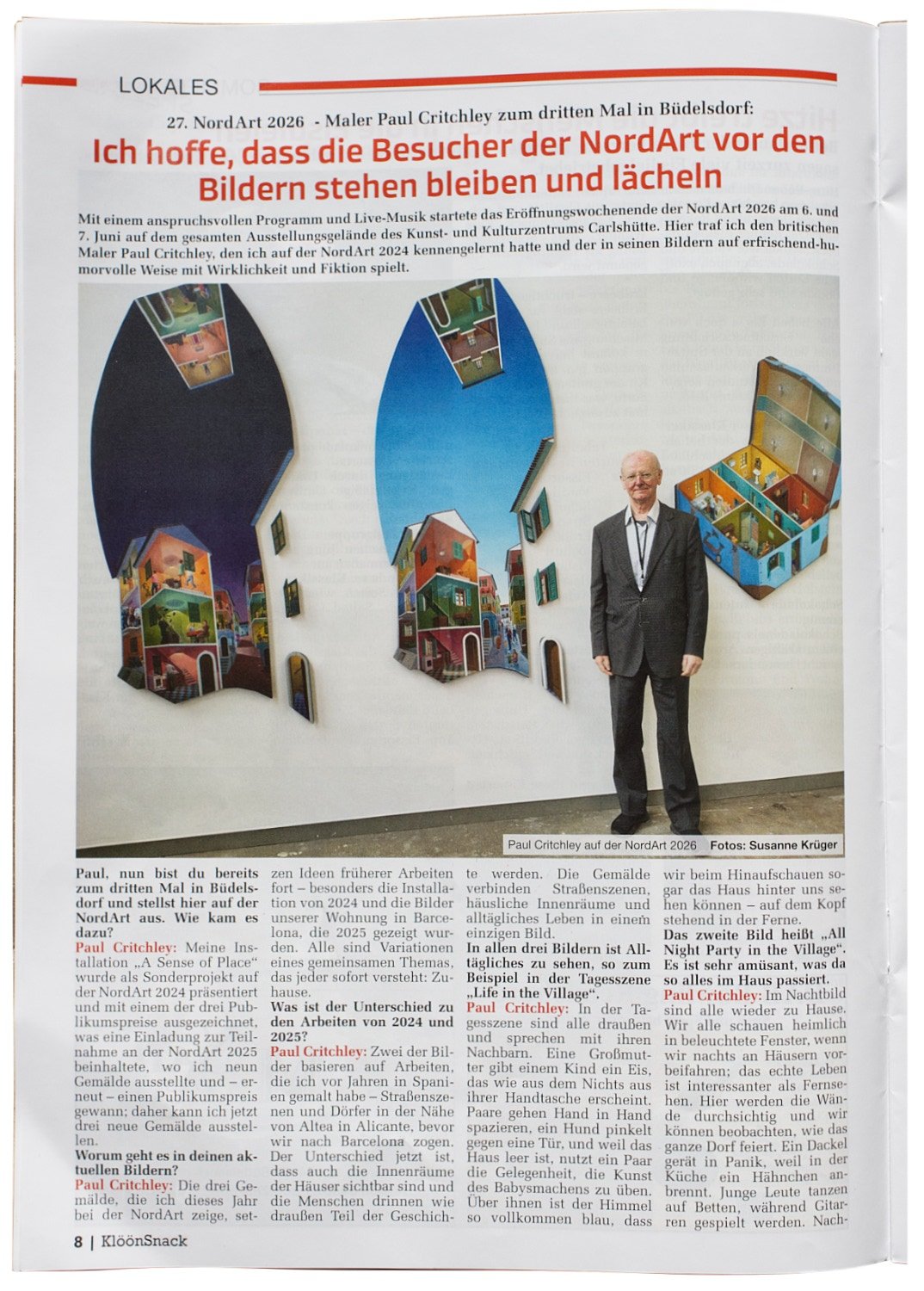
Susanne Krüger interviews Paul Critchley
27th NordArt 2026 - Painter Paul Critchley returns to Büdelsdorf for the third time:
I hope that visitors to NordArt will pause in front of the paintings and smile
With a varied programme and live music, the opening weekend of NordArt 2026 got underway on 6 and 7 June across the entire exhibition grounds of the Carlshütte Art and Culture Centre. It was here that I met the British painter Paul Critchley, whom I had got to know at NordArt 2024 and whose paintings play with reality and fiction in a refreshingly humorous way.
Paul, this is now your third time in Büdelsdorf, exhibiting here at NordArt. How did that come about?
Paul Critchley: My installation ʻA Sense of Placeʼ was presented as a special project at NordArt 2024 and awarded one of the three audience prizes, which included an invitation to take part in NordArt 2025, where I exhibited nine paintings and – once again – won a publicʼs choice award; so now Iʼm able to exhibit three new works.
What are your current pictures about?
Paul Critchley: The three paintings I am exhibiting at NordArt this year build on ideas from earlier works – particularly the installation from 2024 and
the paintings of our flat in Barcelona, which were exhibited in 2025. All are variations on a common theme that everyone understands immediately: home.
What is the difference compared to the work carried out in 2024 and 2025?
Paul Critchley: Two of the pictures are based on works I painted years ago in Spain – street scenes and villages near Altea in Alicante, before we moved to Barcelona. The difference now is that the interiors of the houses are also visible and the people inside, just as those outside, become part of the story.
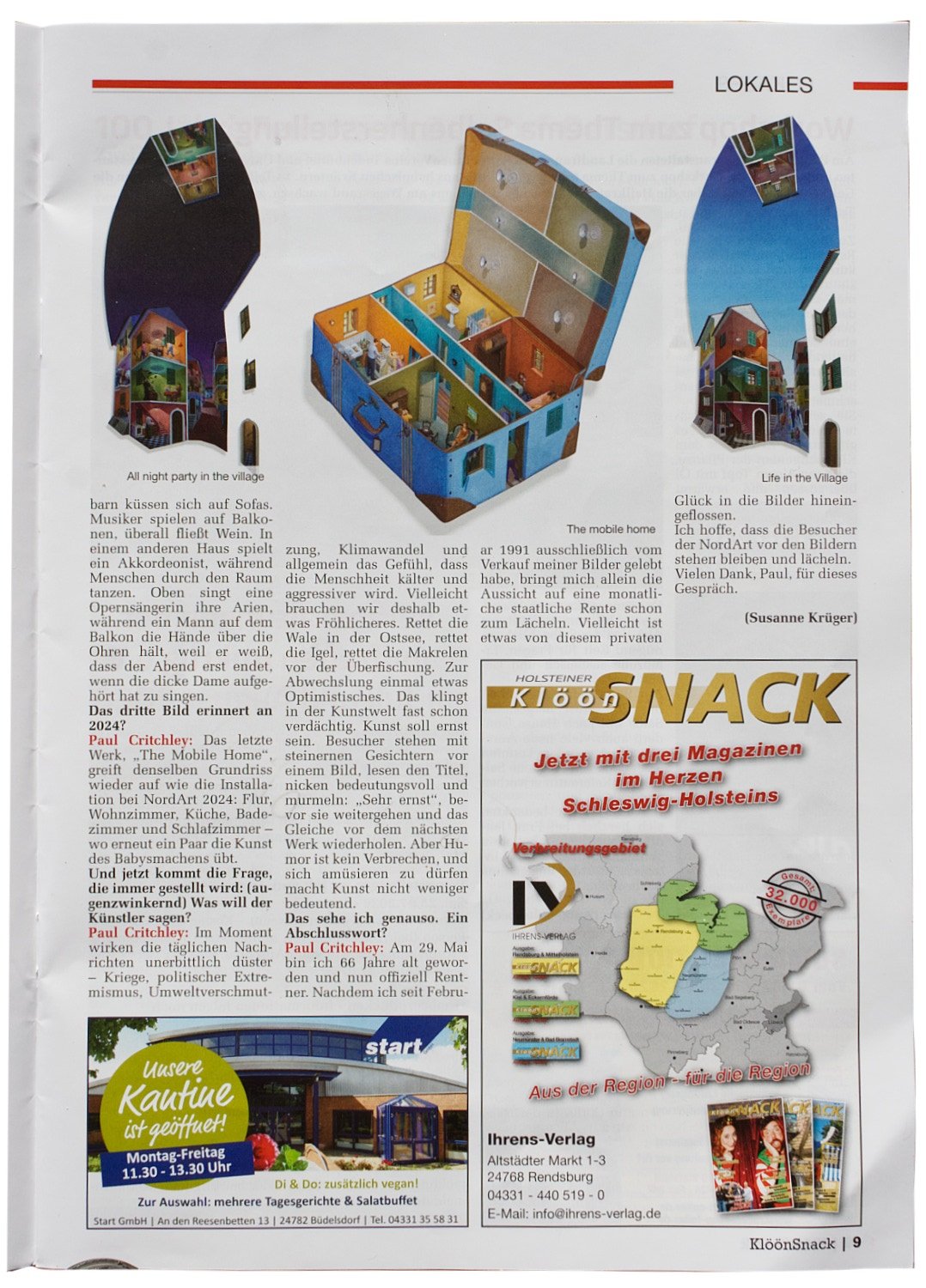
The paintings combine street scenes, domestic interiors and everyday life in a single image.
All three pictures depict everyday scenes; for example, the daytime scene ʻLife in he Villageʼ.
Paul Critchley: In the daytime scene, everyone is outside and chatting to their neighbours. A grand- mother gives a child an ice cream, which appears as if out of nowhere from her handbag. Couples are strolling hand in hand, a dog is peeing against a door, and because the house is empty, a couple seize the opportunity to practice the art of making babies. Above them, the sky is so perfectly blue,
that when we look up, we can even see the house behind us - standing on its head in the distance.
The second picture is called ʻAll Night Party in the Villageʼ. Itʼs quite amusing to see all the things that are going on in the house.
Paul Critchley: In the nighttime scene, everyone is back home. We all sneak a peek at the lit-up windows when we drive past houses at night; real life is more interesting than television. Here, the walls become transparent and we can watch the whole village celebrating. A dachshund panics because a chicken is burning in the kitchen. Young people are dancing on beds whilst guitars are played.
Neighbours are kissing on sofas. Musicians are playing on balconies, and wine is flowing everywhere. In another house, an accordionist is playing whilst people dance around the room. Upstairs, an opera singer is singing her arias, whilst a man on the balcony is covering his ears because he knows the evening wonʼt end until the fat lady has finished singing.
Does the third picture remind you of 2024?
Paul Critchley: The last work, ʻThe Mobile Homeʼ, revisits the same layout as the installation at NordArt 2024: hallway, living room, kitchen, bathroom and bedroom – where, once again, a couple are practising the art of making babies.
And now comes the question thatʼs always asked: (with a twinkle in the eye) What is the artist trying to say?
Paul Critchley: At the moment, the daily news seems relentlessly gloomy – wars, political extremism, environmental pollution, climate change and, in general, the feeling that humanity is becoming colder and more aggressive. Perhaps that is why we need something a bit more cheerful. Save the whales in the Baltic Sea, save the hedgehogs, save the mackerel from overfishing. For a change, something optimistic. That almost sounds suspicious in the art world. Art is supposed to be serious. Visitors stand with stone-faced expressions in front of a painting, read the title, nod meaningfully and mumble: ʻVery seriousʼ, before moving on and repeating the same in front of the next work. But humor is no crime, and being allowed to enjoy oneself does not make art any less significant.
I feel exactly the same way. Any final thoughts?
On the 29th May I turned 66 and I am now officially a pensioner. Having lived exclusively from the sale of my paintings since February 1991, the mere prospect of a monthly state pension is enough to make me smile. Perhaps some of this personal happiness has found its way into the paintings. I hope that visitors to NordArt will stop in front of the paintings and smile.
Thank you very much, Paul, for this conversation.
(Susanne Krüger)